
ACL Return-to-
Performance Testing.
You're ready when the data says so. Not when the calendar does.
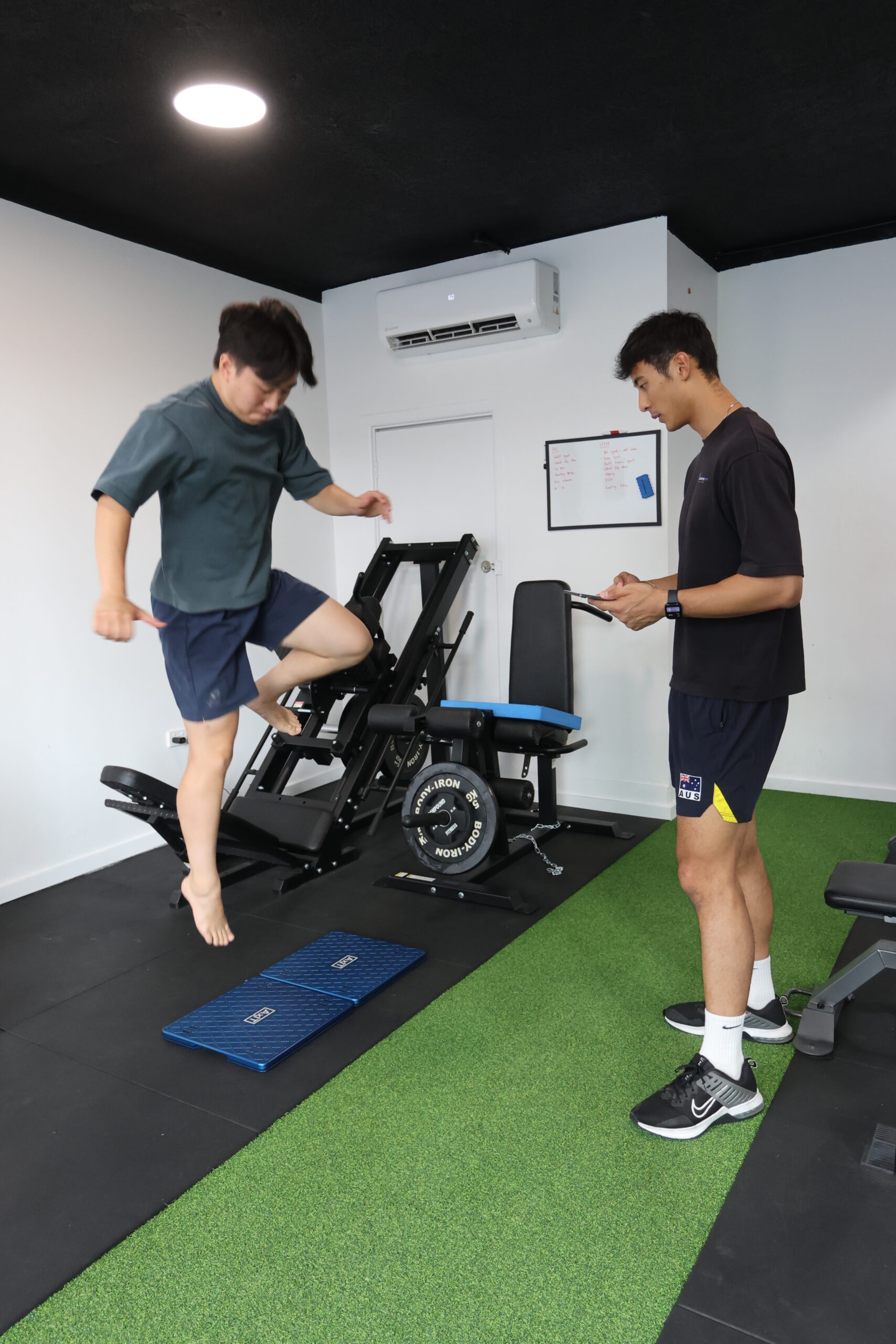
Our ACL Return-to-Performance Testing Protocol uses force plates, isometric strength testing, and sport-specific functional assessments to provide objective, data-driven clearance for return to sport. We don't clear athletes on gut feel or time alone.
 Book a Testing Session
What We Test
Book a Testing Session
What We Test
Why it matters
Time-based clearance
isn't enough.
The single biggest predictor of ACL re-injury is premature return to sport. And premature return is overwhelmingly driven by time-based clearance — "you're 9 months post-op, you're ready" — rather than objective criteria. The data tells a different story.
ACL re-injury rates in athletes who return to sport without passing objective strength criteria are 2-4 times higher than those who do. A limb symmetry index below 90% on return to sport is one of the strongest independent risk factors for re-rupture.
Research consistently shows that passing a battery of objective tests — strength symmetry, hop tests, psychological readiness — before return to sport significantly reduces re-injury risk. Time alone does not.
We use the same testing battery at regular intervals throughout rehab — not just at clearance. You see the data at every stage. You know where you are. You know what you need to achieve. No surprises at the end.
The testing battery
What we test —
and what we're looking for.
Our return-to-performance battery covers four domains: strength, power, function, and psychology.
Counter-movement jump and drop jump testing. Bilateral comparison of ground reaction force, power output, and landing mechanics. Asymmetry in these measures predicts re-injury risk.
Quadriceps and hamstring strength testing at defined joint angles. Limb symmetry and hamstring-to-quad ratio. The most direct measure of muscle recovery after ACL surgery.
Single-leg hop for distance, triple hop, crossover hop, and 6-metre timed hop. A four-test battery validated in the ACL research literature for return-to-sport assessment.
The ACL-Return to Sport after Injury (ACL-RSI) scale measures psychological readiness, fear of re-injury, and confidence in the knee. Low scores independently predict re-injury even when physical criteria are met.
ACL testing session — what it looks like
Our outcomes
What criteria-based clearance produces.
Standalone testing
Already in rehab elsewhere?
We'll test you.
Our ACL Return-to-Performance Testing is available as a standalone service — even if you're doing your rehab at another clinic. Many athletes use us for objective clearance when their current physio doesn't have access to force plates or ForceFrame.
A full 60-minute session covering force plate LSI testing, VALD isometric strength assessment, four-hop test battery, and ACL-RSI psychological readiness scale. A written report is provided at the end of the session documenting all results, comparison to published benchmarks, and a clinical recommendation regarding return-to-sport readiness.
Athletes approaching 9 months post-op who want objective data before returning to sport. Athletes whose current physio has recommended return but who want independent verification. Athletes who feel they're "not quite right" but don't know why. Coaches and sports medicine teams who want objective documentation before a player returns to competition.
Ready to find out
if you're ready?
Book an ACL Return-to-Performance Testing session at Five Dock or Gladesville. Same-week appointments available.
Book a Testing Session